Glean is worth considering when staff need answers from several systems and permission before taking the next action. It directly describes read and write permissions and approval before execution. Ask to see those work with your service accounts.3,1,4These are specific documented controls for this job. We have not tested their effectiveness.
Best for
Internal service assistants that use restricted information and take selected actions with approval.
Avoid when
Your launch depends on a policy feature still marked as coming soon in the reviewed material.
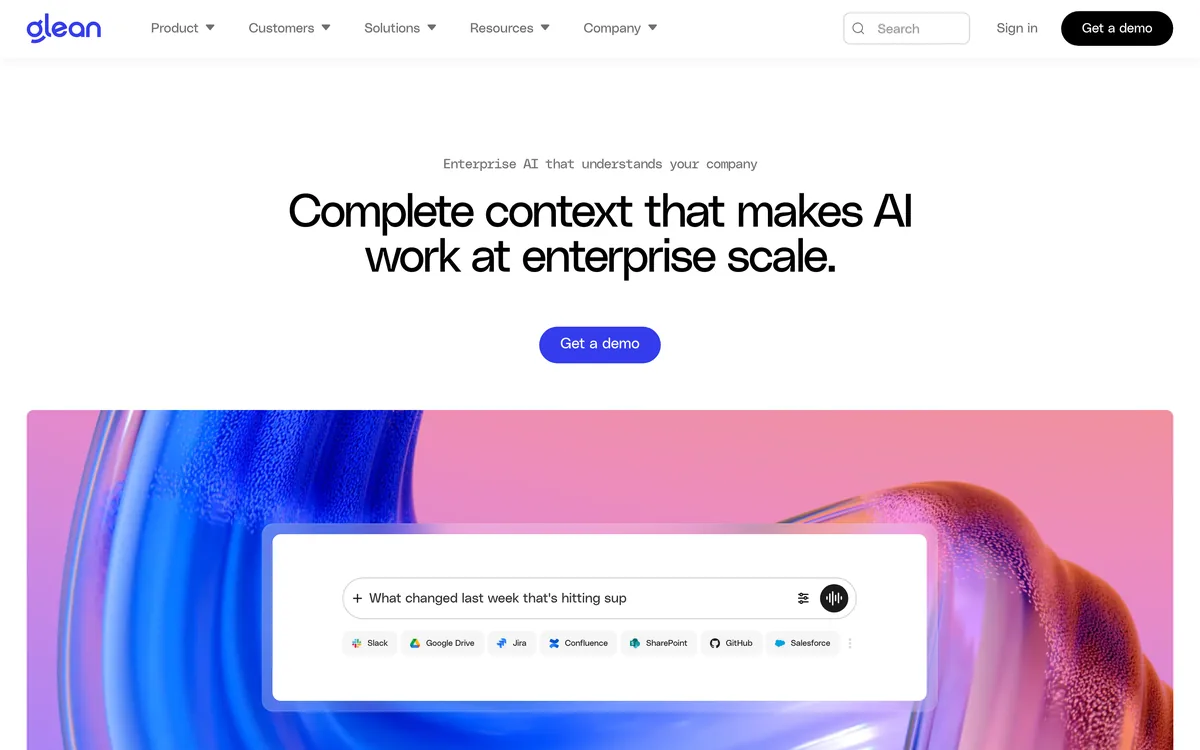
Glean: Glean homepage with the headline complete context that makes AI work at enterprise scale and a search box. Source: glean.com, checked 9 November 2026.
In a regulated firm, the most common early worry about internal AI is simple: an employee asks a question and receives an answer drawn from a file they were never meant to see. Information barriers, client confidentiality and need to know rules exist for good reasons, and an assistant that ignores them creates a compliance incident. Glean's public material is built around that worry. Its central promise is that permissions in the source systems carry through to every answer, and that promise is the main reason it earns a place in this ranking.
Glean is placed fifth for FCA-regulated firms. It has a broad certification list and permission enforcement stated on several pages, and a bank executive appears on its home page. It sits behind the four contenders above because several of its agent governance controls are marked coming soon or beta, because data residency is not publicly stated on the pages we opened, and because a standard delivery model and a price are not published on the pages we opened7.
The profile draws on Glean's public pages as checked on 8 November 2026. Each statement carries a source number, and a gap in the pages is reported as a gap.
From search to agents
The company's account of itself begins with enterprise search. It says it started there and grew into an enterprise AI platform built on company context8. The home page title reads Enterprise AI that Works9. Glean launched publicly with search already in use at more than 40 companies10, raised 100 million dollars at a 1 billion dollar valuation within a year of launch11, and later launched Agents to complete work across systems while reaching a 7.2 billion dollar valuation12. Annual recurring revenue stands at 300 million dollars according to the about page13, three times the 100 million dollars of 15 months earlier14. The company is led by its founder, Arvind Jain, who is also chief executive15.
For a third party risk review, those are the figures of an established, well funded supplier. A firm's procurement team will treat them as company statements and ask for its own financial evidence in the usual way.
Products
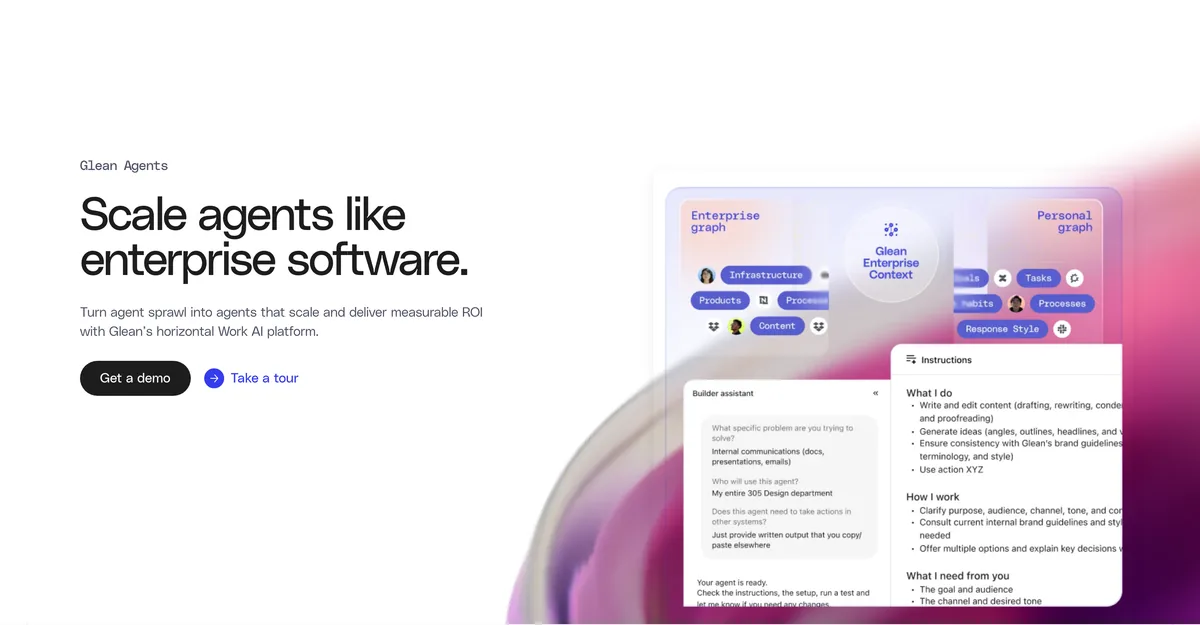
Glean: Glean Agents page with an agent builder panel next to a graph of company knowledge. Source: glean.com/product/agents, checked 9 November 2026.
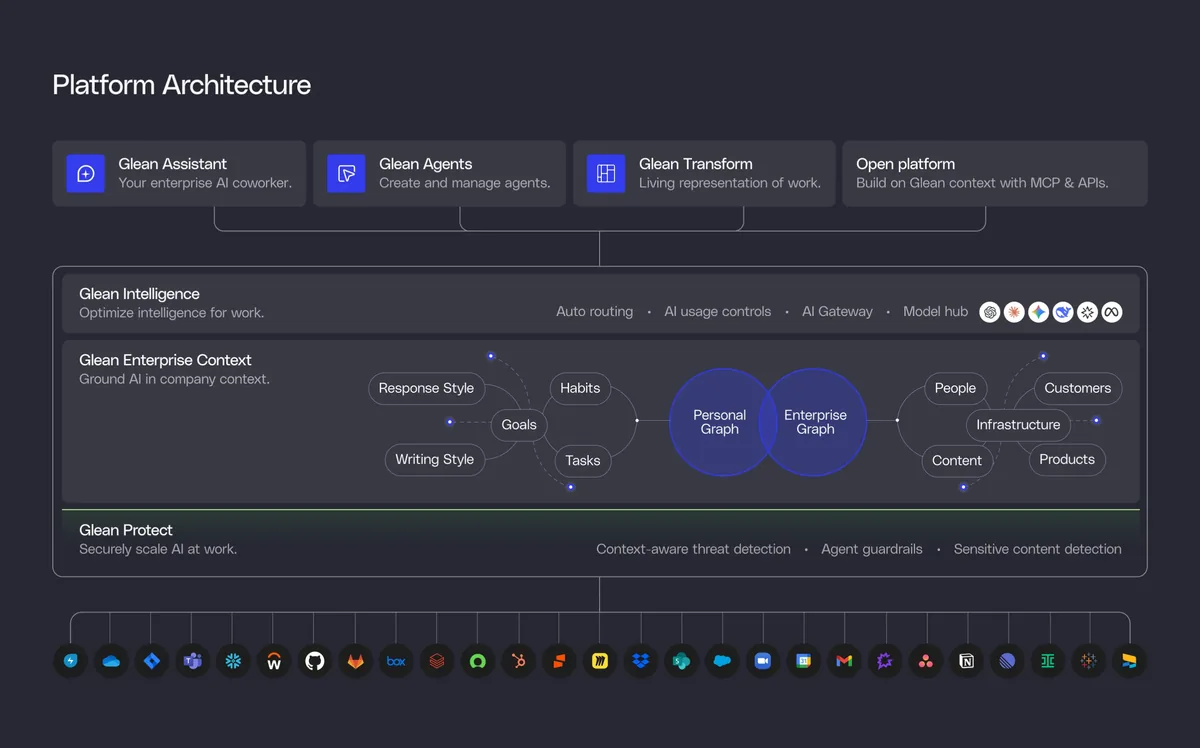
Glean's platform page puts context at the centre, describing it as the foundation for AI that can take on work16. The home page names Glean Enterprise Context as a product line17. The Assistant is pitched as an AI coworker for the enterprise18. Glean Search is described as next generation enterprise search19, with real time, permissions aware search across more than 100 tools20.
The architecture is described in three parts. In Glean's account, connectors gather enterprise signals, the search layer indexes them and the Enterprise Graph maps the relationships and processes among them21. A component called Glean Intelligence picks a model for each task from a pool of more than 40 open and frontier models22, and the platform page promises flexible model choice23. Search continuously trains on a company's own language and context24 and uses deep learning LLMs for natural language queries25.
Developers can build on the same foundation. The platform lists Search, Chat and Agents APIs26,27,28 and supports open APIs, a web SDK and headless MCP29. In the developer documentation, four APIs carry a generally available label, Search, Chat, Agents and Skills30, while Triggers, Usage, Users, Departments and Admin remain experimental31. Developers get client libraries in four languages, Python, TypeScript, Go and Java32, plus a published MCP server endpoint33.
Permissions: the core of the offer for this audience
Glean states its permission model in several places, and the consistency is itself reassuring. Every read and every write is checked against the permissions held in the source system3. Connectors inherit and enforce those permissions34. When permissioning rules change in a source application, the change is reflected in results immediately35. Search enforces the existing permissions of data sources in its results36.
For a firm that runs information barriers between, for example, a corporate finance team and a research team, this is the right design. The answer an employee receives is bounded by what that employee could already open. The design also has a consequence the firm must accept. If permissions in a source system are too wide, Glean will reflect that width faithfully. A permissions review of the main repositories is therefore a sensible step before any rollout.
Several connector examples show per user access in practice. BigQuery analysis runs with each user's access37. Users can connect their own Jira, Gmail and other accounts for use in answers38. For Slack, Glean uses real time search APIs39. According to the documentation, each connector brings an application in by indexing its data in a way that respects permissions40.
Agent controls
Agents that act need a further layer of control, and Glean publishes several. Before an agent acts, Glean checks the action against what the user intended and is authorised to do41. Human approval can be required before actions execute1. Agents may also run on service credentials that administrators scope and manage4. Skill scanning has its own section in the documentation42, and the about page leaves the customer in charge of what AI may reach and which safeguards apply43.
Human approval before execution1 is the control most relevant to Consumer Duty style concerns, because it lets a firm keep a person in the loop for any action that could affect a customer. A firm should test where that approval appears, who can grant it and how it is logged.
Glean is open about what is not yet finished. Enforcement of agent governance policies is marked coming soon5. Different policies for select agents or users are also marked coming soon6. Controls on agentic browser use carry a beta label44. Built in security scans cover skills, with memory coming soon and agents in beta45. A firm that plans to let agents act widely should treat these labels as the current state of the product and confirm each at contract time.
Security and certifications
Six items appear on both the home page and the security page46: SOC 2 Type II47, ISO 2700148, ISO 4200149, GDPR50, HIPAA51 and TX-RAMP Level 252. Hebbia, Nexus and WRITER also list ISO 4200153,54,55, so Glean is one of four contenders here that name the AI management standard.
The security page describes runtime controls. An always on audit trail records events, which can be streamed into a SIEM2. A single sign on provider verifies who is making each request before AI runs, for users and agents alike56. Two accuracy claims sit on the same page: 96.9 percent for spotting prompt injection57, and 95 percent for telling real risk from noise in unstructured data58. Both are company figures. A bug bounty programme accepts vulnerability reports59.
For a compliance function, a SIEM feed2 means agent events can sit alongside the firm's existing security monitoring, which simplifies evidence gathering after an incident.
Hosting and data location
The evidence on hosting is partial. SafetyCulture is cited on the security page as running Glean inside its own cloud tenant60. The platform states multi cloud support23, and an Ericsson case refers to hybrid AI governance61. Which regions data can reside in is not publicly stated on the pages we opened.
For a UK firm this is the main open question. A GDPR compliance claim50 does not say where data is stored or processed. A firm should ask which regions are available, whether its own cloud tenant is an option for its size, and how sub processors are handled.
Integrations
The headline figure is more than 275 connectors62, repeated on the connectors page as ready made connections across enterprise applications and ecosystems63. The documentation connector hub lists 10764, and the search page refers to more than 100 tools20. A firm should check its own systems against the current list.
Where an application is missing, teams can request new connectors65, add custom data with the Indexing SDK66, create actions from an OpenAPI specification67 or connect MCP enabled tools68. Each of those routes is engineering work that the firm would need to own.
Implementation
The administrator documentation has a page on setting up Glean for an organisation69. A standard implementation timeline and steps are not publicly stated on the pages we opened beyond customer reported timelines. A customer quoted on the home page reports being live within three weeks70. A TIME case study shows 3 weeks to go live71 and also a 5 month enterprise integration72. A project plan should specify which of those milestones it is measuring.
Who carries out the work and what the firm must prepare are not set out on the pages we opened. This is the main difference from Nexus on delivery accountability.
Pricing
Glean's price is not publicly stated. Its pricing address sends visitors back to the home page, and none of the pages read carried plan or price text7. The platform page says Glean Intelligence optimises AI for price and performance73, which is a product claim about model selection. A firm will need a quotation that sets out the basis of charge.
Customers and use cases
Glean names large organisations. The case studies are large: AI rolled out to 14,000 employees at Booking.com74, adoption of 80 percent at Zillow75 and upwards of 2,700 agents at Ericsson76. The Chief Transformation Officer of DBS Bank is quoted on the home page77, which is the clearest financial services reference on the pages. A T-Mobile quotation mentions reducing transfers to live agents78.
By function, Glean says it unifies code, tickets, docs and incident history for engineers79, and for professional services it builds past proposals, deliverables and expert knowledge into client ready work80. It lists Customer Service among departments81. The home page figure of 110 hours saved per user per year is a company reported number82.
Limits to weigh
The limits a regulated firm should weigh come from Glean's pages or from their silence. Agent governance policy enforcement is coming soon83, browser use control is in beta84 and several developer APIs are experimental31. Any application missing from the list has to be requested or connected with custom work85. A regulated buyer would want three answers early, and none of them is publicly stated on the pages we opened: the price, the data residency options and a typical implementation timeline. The security page also carried placeholder text when the facts were gathered86, a small sign that the page was still being edited.
Questions an FCA-regulated firm should put to Glean
Several of the open points above are best settled before a contract is signed. The list below turns them into questions.
1. In which regions can the firm's data be stored and processed, and is UK processing available?
2. Is hosting in the firm's own cloud tenant, as at SafetyCulture60, open to a firm of its size?
3. When will agent governance policy enforcement and policies for select agents or users move out of coming soon5,6, and what controls apply until then?
4. Where does the human approval step before agent actions1 appear, who may approve, and how is the approval recorded in the audit trail2?
5. What is the basis of charge7, and which products does it include?
6. Who carries out the implementation, and what must the firm prepare?
7. Which of the firm's core systems appear in the current connector list62,64, and which would need the Indexing SDK or a custom action66,67?
Answers to these questions in writing would let the firm compare Glean with Nexus on equal terms.
Verdict
For an FCA-regulated firm whose first need is a permission respecting assistant across many internal systems, Glean is a serious option. Its permission enforcement is stated consistently3,34,35,36, it supports human approval before agent actions1, its audit trail can feed a SIEM2 and its certification list includes ISO 42001 and SOC 2 Type II49,47.
It ranks fifth because agent governance features a firm would rely on for customer facing work are still coming soon or in beta5,6,44, because data residency and price are not publicly stated on the pages we opened7, and because no standard delivery model is described on the pages we opened. Nexus is placed first on accountable delivery and its release gate. Confirm which controls are available in production on the proposed plan before relying on them in a customer journey.
What buyers should test
We read dated supplier material and identify the product each claim covers. We separate those claims from our advice and questions. Information supplied directly by Nexus is labelled as such. We have not tested the products, and a feature description does not establish how your service will work.
Customer resolution
Not established
How will you tell whether an answer resolved the customer’s request, rather than finding related information?A question to settle with the supplier for your service. It is not a finding about capability or compliance.
Evidence
Which unfinished requests go to a queue someone is responsible for answering?
Agree a customer example, what falls outside it and what counts as finished. Include difficult cases and compare with the service you run today.
When staff step in
Documented
Glean documents requiring approval before agent actions run.1Supplier material checked on 8 November 2026. We have not tested the described feature or measured the result.
Evidence
Can the exact connection and account you plan to use enforce rejection and timeout rules?
Ask to see what the reviewer receives. Try approval, rejection and no reply, then check that a refused action has changed nothing.
The case record
Partly documented
Glean describes an always-on audit trail with events that can be sent to a security monitoring system, or SIEM.2Supplier material checked on 8 November 2026. We have not tested the described feature or measured the result.
Evidence
Which event connects the person’s approval to the action result and the message sent to the customer?
Request a case export with personal details removed. Look for source and policy versions, action references, the approver, the final result and any missing events.
Access to customer data
Documented
Glean says source-system permissions apply to every read and write. It also describes scoped service credentials managed by administrators.3,4Supplier material checked on 8 November 2026. We have not tested the described feature or measured the result.
Evidence
Can the demonstration show the difference between a user’s access and the service account’s access?
List the account behind each connection and its permissions. Try a restricted user, a refused action and a task after access has been removed.
Who runs the service
Partly documented
The security page checked for this review marks agent governance policies and separate policies for selected agents or users as coming soon.5,6Supplier material checked on 8 November 2026. We have not tested the described feature or measured the result.
Evidence
Who maintains the policies available in the release you buy, and what setup help is included?
Name the customer and supplier responsibilities. Include launch checks, support cover, changes, training, handover and what happens when the contract ends.
Pricing: not publicly stated. Pricing URL redirects to the home page, and no plan or price text was found on the pages read. glean.com/pricing, checked 8 November 2026.
Glean began as enterprise search. glean.com/about, checked 8 November 2026.
Home page title calls Glean enterprise AI. glean.com, checked 8 November 2026.
Glean launched publicly with enterprise search in use at 40+ companies. glean.com/about, checked 8 November 2026.
Glean raised $100M at a $1B valuation less than a year after its public launch. glean.com/about, checked 8 November 2026.
Glean launched Agents and reached a $7.2B valuation. glean.com/about, checked 8 November 2026.
About page states ARR of $300M. glean.com/about, checked 8 November 2026.
About page states revenue tripled over 15 months from $100M. glean.com/about, checked 8 November 2026.
Founder and CEO named on the about page. glean.com/about, checked 8 November 2026.
Platform is positioned around company context. glean.com/platform, checked 8 November 2026.
Home page names Glean Enterprise Context as a product line. glean.com, checked 8 November 2026.
Glean Assistant is described as "Your enterprise AI coworker". glean.com, checked 8 November 2026.
Glean Search describes itself as "Next-generation enterprise search helps you instantly find the answers you need.". glean.com/enterprise-search, checked 8 November 2026.
Search page: real-time, permissions-aware search across 100+ tools. glean.com/enterprise-search, checked 8 November 2026.
Glean's context layer: connectors capture signals, search indexes data, the Enterprise Graph maps relationships. glean.com/platform, checked 8 November 2026.
Glean Intelligence matches each task to a model. glean.com/platform, checked 8 November 2026.
Multi-cloud support is stated. glean.com/platform, checked 8 November 2026.
Connector docs: BigQuery queries use each user's access. docs.glean.com, checked 8 November 2026.
Connector docs: apps connected per user. docs.glean.com, checked 8 November 2026.
Slack real-time search via real-time search APIs. docs.glean.com, checked 8 November 2026.
Docs connector hub: "Glean connectors integrate your organization's applications with Glean through permission-aware data indexing". docs.glean.com/connectors, checked 8 November 2026.
Agent actions checked against user intent before execution. glean.com/platform/security, checked 8 November 2026.
Skill safety scanning in docs. docs.glean.com, checked 8 November 2026.
Customers control what AI can access. glean.com/about, checked 8 November 2026.
Prompt-injection detection: "Detect prompt injection attacks with 96.9% accuracy" (vendor claim). glean.com/platform/security, checked 8 November 2026.
Unstructured-data risk scan: "Scans unstructured data to separate risk from noise with 95% accuracy" (vendor claim). glean.com/platform/security, checked 8 November 2026.
Admin docs have a setup page. docs.glean.com, checked 8 November 2026.
Customer quote: live in three weeks. glean.com, checked 8 November 2026.
Customer case study (TIME). glean.com, checked 8 November 2026.
Same TIME case study. glean.com, checked 8 November 2026.
"Glean Intelligence optimizes AI for price-performance" is a product claim and not a price. glean.com/platform, checked 8 November 2026.
Customer: Booking.com scaling AI to 14,000 employees. glean.com, checked 8 November 2026.
Customer: Zillow reports 80% adoption. glean.com, checked 8 November 2026.
Customer: Ericsson reports 2.7k+ agents. glean.com, checked 8 November 2026.
Customer: DBS Bank executive. glean.com, checked 8 November 2026.
Use case, customer service: T-Mobile "reducing transfers to live agents". glean.com, checked 8 November 2026.
Use case, engineering. glean.com, checked 8 November 2026.
Use case, professional services. glean.com, checked 8 November 2026.
Department list includes Customer Service. glean.com/platform, checked 8 November 2026.
Headline metrics such as "110 hours Saved per user/year" are vendor-reported figures and not separate measurements. glean.com, checked 8 November 2026.
Several capabilities are marked coming soon or beta on the security page. glean.com/platform/security, checked 8 November 2026.