Nexus makes sense when your service team knows the process and wants help turning it into an agent. Ask it to turn its joint-build offer and launch checks into named jobs and evidence for your customer journey.5,4The joint-build offer and launch checks fit this need. Your own cases still need to show whether the controls work.
Best for
A defined service task with someone in your firm responsible for it and a supplier helping with the build.
Avoid when
You still lack an answer on a required approval rule, data route or current contract.
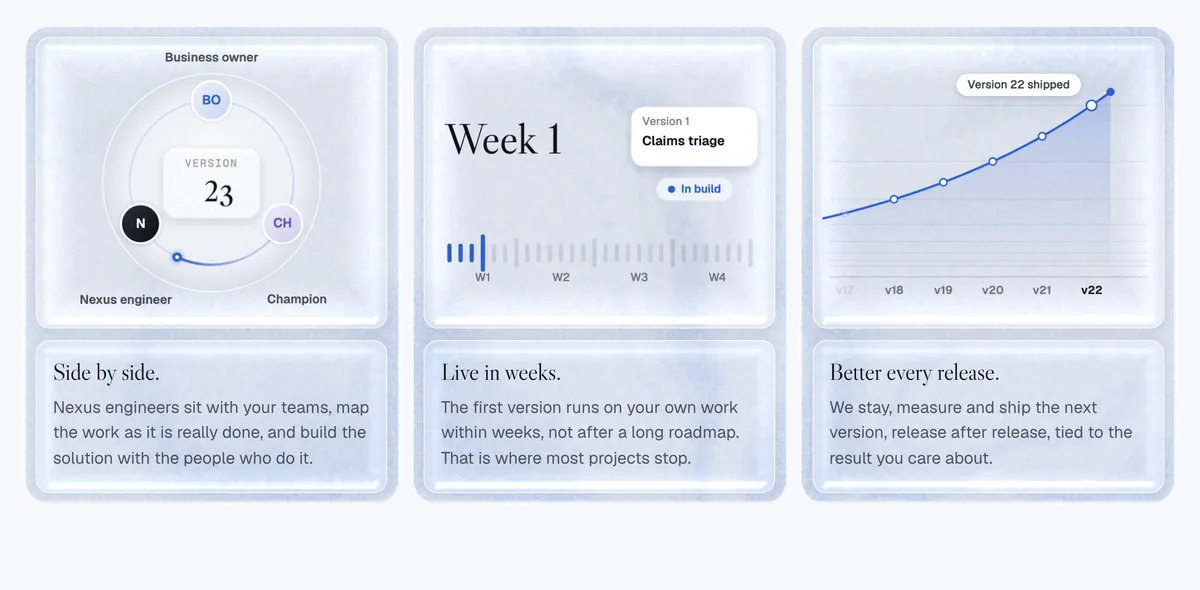
Nexus: three cards on the agent.nexus homepage: side by side, live in weeks and better every release. Source: agent.nexus, checked 9 November 2026.
A bank, insurer or wealth manager that puts an AI agent in front of customers takes on a particular kind of exposure. The agent becomes part of how the firm treats people, and a compliance function will want to know who designed it, what it is allowed to do, how its decisions can be reconstructed and what happens when it is unsure. Those questions sit at the centre of this site's assessment, and they are the reason Nexus is placed first in the ranking for FCA-regulated firms.
Nexus designs its product around procedures that operate themselves7. The idea is to take what a company's strongest people know and turn it into procedures that run on their own8. The legal entity is Nexus Enterprises, which trades as nexusGPT9 and is registered in Delaware10. Nexus Agent dates from 2024, by the company's account11, and its seed round of 4.3 million dollars was led by General Catalyst12. It calls itself early13, and a regulated buyer should hold that in mind throughout, because supplier maturity is part of any outsourcing or third party risk review.
This profile relies on Nexus's public pages as they stood on 8 November 2026, together with a small set of commercial and delivery facts confirmed by Nexus. Each statement carries a source number. Where the pages say nothing on a point a regulated firm would care about, the text says it is not publicly stated on the pages we opened.
Why delivery model matters more in a regulated firm
Most agent platforms hand the customer a toolkit. That works well for a technology company with spare engineers. It works less well for a firm whose change programme already competes with regulatory projects, remediation work and annual attestations, and where every new customer facing process needs sign off from risk, compliance and often the board.
Nexus takes the other route. A Nexus engineer builds the first procedure alongside the client team and shows it working inside the client's own tools5. Version 1 goes live in weeks, after which the Nexus team stays on to improve it with the client14. Nexus confirms a first agent in production 4 weeks into a 3 month proof of concept6. Its engagements are run by experienced consultants, and one of its founders previously worked at McKinsey6.
The company blog describes how that consulting role has changed. The post explains that consultants have taken the place of engineers in the forward deployed role at Nexus Agent15, and that writing integration code or building agents on a client's behalf is no longer part of their job16. That work falls to Cue, which the blog describes as an autonomous build loop17. Cue works through the use case with the user, raises the questions that need answers and links to internal data with the right permissions18; the whole sequence, the post says, takes one to two hours19.
For a compliance team, the practical reading is that a named group of people sits between the business requirement and the deployed agent. Someone outside the firm's own engineering function is accountable for scoping, and someone is there after launch. That is a different proposition from a licence and a set of documentation, and it is the first reason for the placement here.
Evidence of outcomes
A regulated firm often has to show that a change produced the result it was meant to produce, and that the result was good for the customer as well as for the firm. Nexus builds measurement into its engagement model. The blog says every agent it deploys has a measurable business KPI attached from the first day1. When that KPI is not moving, the company says it rescopes the work instead of shipping something that only appears productive20.
This is a useful discipline for a firm that will later have to explain a deployment to its own governance committees. A target agreed before build, measured during the proof of concept and reviewed before scale gives the compliance function something concrete to test. The firm still has to define the customer outcome measures itself; the pages we opened do not describe customer outcome metrics as distinct from business KPIs.
The company reports figures for its own track record. By its own account, Nexus has served 12 enterprises whose market values add up to more than 70 billion dollars, among them Orange Group and Lambda.ai21,22, and has put 174 agents into production23. The 100 percent success rate it quotes is judged against the targets set for each agent at scoping24, which makes it a figure the company reports about itself. The Orange result cited on this site is 6 million dollars of extra lifetime value25. Lambda.ai now runs agents in sales and marketing26, and the sales page puts the annual saving there at more than 10,000 hours of sales rep time27.
Architecture
The architecture is described in layers on the telecom page. Uppermost is a layer that joins all of a company's systems to any team that needs them28. Below it, systems, models and permissions each become a building block that the business can reuse when it puts an agent together29. In the third layer, the team that uses an agent also builds it, deploys it and answers for it30. The sales page names four infrastructure parts behind this: a company brain, governance, permissions and reusable blocks31.
Nexus positions itself as one AI layer that sits above the systems a company already runs32. The model provider is a choice the firm can change later33. For a firm that must manage concentration risk in its technology suppliers, the ability to change model provider without rebuilding the agent is worth noting, although the pages do not set out how a swap is tested or approved.
A role is served by a fleet of agents, assistants, automations and scripts34. Work passes from system to system through one surface35, and what is learned in each build lands in a shared brain36. The company publishes role pages for sales37, marketing38, customer support39, recruiting40 and strategy41.
Governance, audit and escalation
Governance is the area where a regulated buyer will spend most of its diligence time, and Nexus describes several controls in plain terms. Every action can be seen in a single place, and that permissions and guardrails are defined once at the centre42,43. Full audit trails, traceable decisions and access by role all appear on the comparison page3. The blog adds data residency controls to that list and describes the set as something a CIO can sign off on44.
The release gate is the most relevant statement for a firm under FCA supervision. The blog sets a hard condition on release. A CIO must be satisfied on three points, namely how data moves, who can access what and what gets recorded, before any agent ships4. On the telecom page, IT sets the controls and Nexus makes them easy to apply45. After launch, the business team that runs the service owns it46, under the description owned by the business and trusted by IT47.
Escalation is stated as a design rule. An agent that is unsure hands the case on together with its full context2; one that is confident carries on48. For customer facing work this is the behaviour a compliance team will want to see tested: the point at which a human takes over, and what that human receives when it happens.
A research post describes how a third party guardrail classifier can be attached to any agent. All twelve checks share a single call at each step, return within a second and revert to the rule already in place if the service is down49. Each check keeps a plain fallback rule50. TypeSafe, a separate company, released the classifier51, and Nexus did not repeat TypeSafe's benchmarks52. A separate post on memory describes turning specific values, such as a company name or a price, into labelled blanks so that the value stays private53.
Some controls a regulated buyer would expect to review are not publicly stated on the pages we opened. These include single sign on group mapping, administrator role setup and approval workflows. They belong on the proof of concept test plan.
Certifications and data handling
Its comparison page names GDPR, ISO 27001 and ISO 4200154, and Nexus also has a SOC 2 Type 2 report6. A firm that has to evidence how AI risk is governed will take note of ISO 42001 on that list, and the set as a whole is broad for a company that calls itself early13.
The privacy policy has a section setting out legal bases under the GDPR and UK GDPR55. It says data obtained through a user's personal Workspace, for example through Google APIs, is not retained to develop, improve or train generalised AI or machine learning models56. Retention ends eighteen months after an account closes, unless a longer period is legally required57, and the policy says no personal information was sold or passed to third parties for business purposes over the previous twelve months58. The policy says appropriate and reasonable technical and organisational security measures are in place59, and all payment data is held by Stripe60.
Single sign on, encryption standards, penetration test results, access to the SOC 2 report and uptime commitments are the items a security reviewer will ask about next, and on the pages we opened they are not publicly stated. Hosting choices such as on premises, private cloud, a choice of region or EU only processing are also not publicly stated. According to the 2023 terms, which were written for the gpt.nexus website61, hosting is in the United States62 and Delaware law governs the agreement63. The telecom page says the service goes live in the customer's environment in weeks64 without describing the hosting arrangement. A UK firm with data location requirements should put these questions to Nexus in writing before the proof of concept starts.
Integrations
The integration count Nexus gives is above 4,00065, covering CRM and ERP systems, communication tools and custom APIs66. Agents work across those systems with bidirectional integration67 and read live data during execution68. Deployment channels include Slack, Teams, WhatsApp, email, phone and the web69. On the telecom page, billing, network and customer systems are connected from the first day70. SAP, Salesforce, Microsoft Dynamics and ServiceNow are named in the blog as the next systems to integrate71.
A full connector catalogue is not published on the pages we opened. A bank or insurer with a core banking, policy administration or platform system specific to its sector should name that system at the scoping stage and ask to see it connected during the proof of concept.
Commercial terms
The commercial model is one of the clearest differences between Nexus and the other contenders on this site. Nexus charges per role automated; there is no per diem and no fee for consultant time6. The consulting help arrives inside a software pricing model6. For a procurement team that is used to day rate statements of work for AI delivery, that changes how the business case is built.
The comparison page describes the structure around the price. It is not tied to headcount, it starts with a 3 month proof of concept that has measurable outcomes, and an annual commitment follows the proof of concept72. That proof of concept, tied to specific outcomes, is the opening step of every engagement73. If it does not deliver, the customer walks away74, and after it the customer can exit at any time75. According to the home page, all proofs of concept so far have turned into customers76; the company gives no count behind that figure.
A buyer looking for list prices, plan tiers, a free trial or a self serve plan will find that these are not publicly stated on the pages we opened. Under the 2023 terms, no purchase is refundable77, and a subscription can be cancelled from within the account78. Those terms may belong to an earlier self serve offer; the enterprise contract itself has not been published.
Limits a regulated firm should weigh
The most important limit for this audience comes from the Nexus terms. They say the services are not tailored to comply with industry specific regulations, naming HIPAA and FISMA as examples79. The same terms decline to guarantee that the service will always be available80, and the privacy policy says that no method of transmission or storage can be promised to be fully secure81. Both documents were written in 2023 for the gpt.nexus site82 and may not reflect the enterprise service sold today. A firm should obtain the current contract and check with its own compliance and legal teams how regulatory obligations are allocated between the parties.
The public documentation is also thin in places. Price levels, single sign on, encryption detail, hosting choices and the customer's own preparation steps are not publicly stated on the pages we opened. The company is early13, and a firm that must assess supplier resilience will want to see financial and continuity information that the website does not carry.
Verdict
Nexus is placed first for FCA-regulated firms because its public governance documentation and separate company-confirmed delivery and pricing model address the questions a compliance function asks before an agent reaches a customer. Nexus confirms that experienced consultants run engagements6. Each agent has a KPI from day one and is rescoped when the number does not move1,20. Agents do not ship until data flow, access model and audit trail are signed off4, and they escalate with context when uncertain2. Its public listing includes ISO 4200154; Nexus separately confirms that a SOC 2 Type 2 report exists6. The commercial model starts with a 3 month proof of concept that the firm can walk away from73,74, priced per role automated6.
The gaps are real and specific: hosting location, single sign on, encryption detail and the regulatory wording in the older terms all need written answers. Make these written answers and their supporting evidence part of the proof of concept's release criteria.
What buyers should test
We read dated supplier material and identify the product each claim covers. We separate those claims from our advice and questions. Information supplied directly by Nexus is labelled as such. We have not tested the products, and a feature description does not establish how your service will work.
Customer resolution
Partly documented
Nexus says every deployed agent has a measurable business KPI from day one.1Supplier material checked on 8 November 2026. We have not tested the described feature or measured the result.
Evidence
Which measure shows the customer got what they needed, and which record shows who is still waiting?
Agree a customer example, what falls outside it and what counts as finished. Include difficult cases and compare with the service you run today.
When staff step in
Partly documented
Nexus says agents pass uncertain cases on with the full context.2Supplier material checked on 8 November 2026. We have not tested the described feature or measured the result.
Evidence
Can you block an action needing staff approval even when the agent is confident?
Ask to see what the reviewer receives. Try approval, rejection and no reply, then check that a refused action has changed nothing.
The case record
Partly documented
Nexus lists audit trails and decision traceability. Its launch checks include sign-off on the audit trail.3,4Supplier material checked on 8 November 2026. We have not tested the described feature or measured the result.
Evidence
Can you export the proposed response, its approval and the delivered result for the same case?
Request a case export with personal details removed. Look for source and policy versions, action references, the approver, the final result and any missing events.
Access to customer data
Partly documented
Nexus lists access based on roles and makes the access model part of its launch checks.3,4Supplier material checked on 8 November 2026. We have not tested the described feature or measured the result.
Evidence
Which account reads or changes the customer record, and where is a refused action recorded?
List the account behind each connection and its permissions. Try a restricted user, a refused action and a task after access has been removed.
Who runs the service
Documented
Nexus confirms that experienced consultants run engagements and prices are per role automated, not based on consultant time.6Nexus supplied these staffing and pricing details on 8 November 2026. Its homepage does not verify them, and we have not assessed an engagement.
Evidence
Nexus’s public site describes an engineer building the first procedure with the team in its own tools.5
Who supervises the service and puts mistakes right after the first build?
Name the customer and supplier responsibilities. Include launch checks, support cover, changes, training, handover and what happens when the contract ends.
Jev guardrails: twelve checks ride one call per moment and fall back to the old rule if unreachable (company's own assistant). agent.nexus/blog/jev-guardrails-for-any-agent, checked 8 November 2026.
Privacy: GDPR and UK GDPR legal-bases section (a legal basis statement and not a certification). agent.nexus/privacy-policy, checked 8 November 2026.
Privacy: data from a user's Workspace (e.g., Google APIs) is not used to train generalized AI or ML models. agent.nexus/privacy-policy, checked 8 November 2026.
Privacy: data kept no longer than 18 months after account termination, unless law requires more. agent.nexus/privacy-policy, checked 8 November 2026.
Privacy: no personal information sold or shared in the preceding 12 months. agent.nexus/privacy-policy, checked 8 November 2026.
Terms (2023, gpt.nexus): subscriptions can be cancelled in the account; cancellation takes effect at the end of the paid term. agent.nexus/terms-and-conditions, checked 8 November 2026.
Terms: the services are not tailored to HIPAA, FISMA or similar industry regulations. agent.nexus/terms-and-conditions, checked 8 November 2026.