Gemini Enterprise may fit a team comfortable with Google Cloud accounts and permissions. Specify the app edition and any Agent Platform work separately. Access to knowledge in the app does not settle what a custom agent may do.5,7,1Google documents these accounts and permissions. You still need to decide how to use them in your service.
Best for
Teams able to specify and manage the Google Cloud products they will use.
Avoid when
The proposal combines the app and Agent Platform into one purchase or assumes their controls are interchangeable.
Google Gemini Enterprise for FCA-regulated firms: an assessment
Google Gemini Enterprise: Gemini Enterprise page on Google Cloud with the headline Meet Gemini and a contact sales button. Source: cloud.google.com/gemini-enterprise, checked 9 November 2026.
In Google's own documentation, Gemini Enterprise combines intranet search, an AI assistant and an agentic platform8. In the FAQ, the app is presented as an advanced agentic platform meant to put Google's AI in the hands of every employee9. For a regulated firm, the interest lies less in the breadth of that ambition and more in how precisely Google documents its controls over identity, encryption, data location and agent behaviour. On those points the documentation is detailed, and that detail is why Gemini Enterprise is placed fourth in this ranking for FCA-regulated firms.
It sits behind Nexus, Hebbia and Microsoft Copilot Studio for three reasons that emerge below. The route to a working agent is self service, with setup carried out by the customer's own administrators10,11. For the Standard and Plus editions, seat prices are not publicly stated on the pages we opened12. And a number of data protection features carry conditions that a compliance team has to map carefully.
This profile uses Google Cloud's own public pages, checked on 8 November 2026. Several Google pages returned a not found body when the facts were gathered, including the pricing page12, and nothing else is drawn from them.
Products and editions
Google sells two related things. The Gemini Enterprise app is the employee facing product, and the Gemini Enterprise Agent Platform is described as the evolution of Vertex AI13. Google sells them as separate purchases7. A firm should be clear which of the two a proposal covers, because controls and billing differ between them.
The app comes in several editions designed for different organisational needs14. Google documents four editions together (Standard, Plus, Frontline and Pay as you go) and gives Business a help centre of its own15. The Business edition targets small companies and teams of no more than 300 people16. Standard and Plus add higher quota, unlimited seats, third party agents and Gemini Code Assist17, and the Frontline edition is an add on for frontline workers18,19. Gemini Notebook Enterprise is offered next to the app as an assistant for research and knowledge work20.
For a regulated firm of any size, Standard or Plus is the relevant edition, since several of the controls discussed below are documented for those editions specifically.
How agents are built and used
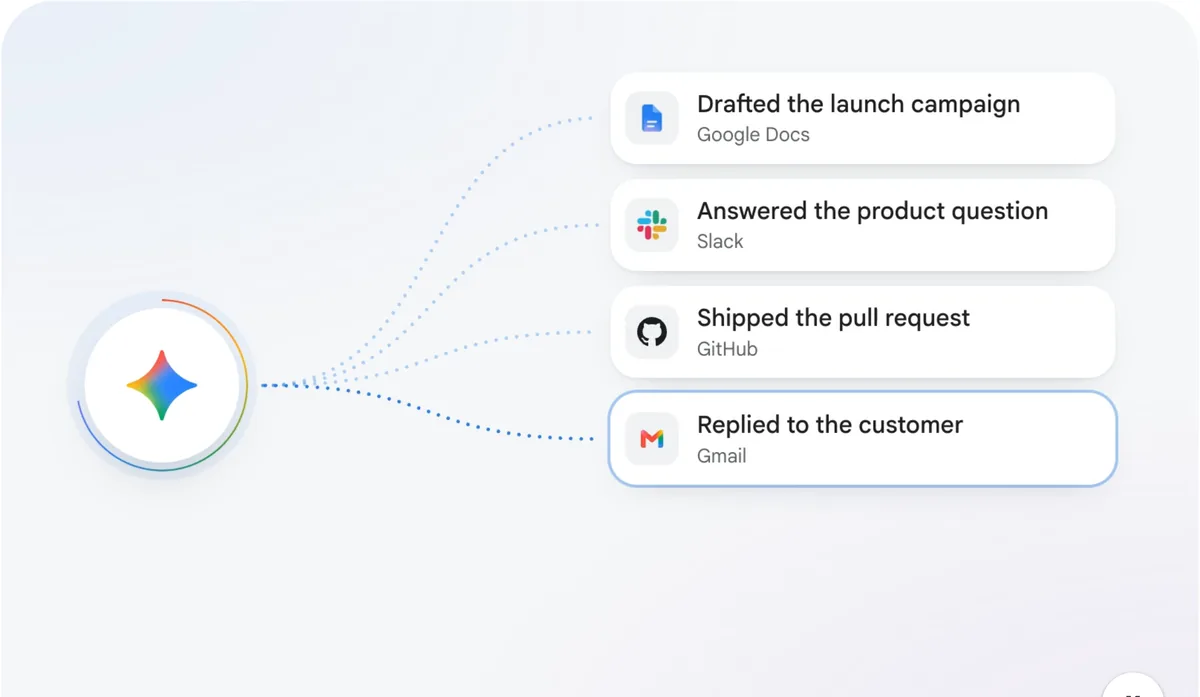
Google Gemini Enterprise: Gemini agent linked to finished tasks in Google Docs, Slack, GitHub and Gmail. Source: cloud.google.com/gemini-enterprise, checked 9 November 2026.
Employees can create their own agents with a no code workbench6. Two agents come ready made: Deep Research21 and, in preview on Standard and Plus, a Data Insights Agent22. On Standard and Plus, agents a firm builds with the Agent Platform or the Agent Development Kit can go straight into the app23, and outside agents can join through the A2A protocol24. Partner built agents are available in Agent Marketplace25.
That openness to employee built agents is useful for productivity, and it is also the point a compliance function will look at first. A firm will want to decide which employees may publish agents, which data those agents may reach and who reviews them before use. Google's governance features, covered next, are the tools for that.
Governance and agent identity
Google describes the app as a single pane of glass for centrally governing all agents across teams26. Administration of the enterprise editions rests on three things: Cloud IAM, Workforce Identity Federation as the single sign on layer, and the access control lists held in each source system5. Only administrators and users provisioned in Cloud IAM can get in27, and access rules are applied document by document to reduce the chance of leakage28. Before licences are assigned, administrators must grant at least the Gemini Enterprise User role29.
Agent level governance on the Agent Platform is specific. Every agent is issued its own secure SPIFFE ID1. Context Aware Access protects those identities by default30. Traffic to and from agents passes through an Agent Gateway31. A firm can write the rules for how agents use tools in plain language2. Model Armor, which comes with every edition of the app32, checks prompts and tool responses as they happen in order to stop prompt injection33.
For a firm that must show who or what took an action, a unique identity for each agent is a strong foundation. It allows logs to separate actions taken by an agent from those taken by a person, which is a recurring question in any review of automated decisions.
Usage can also be contained. To stop one person consuming a shared pool, administrators can set a limit for each user34. Business edition administrators manage team membership and decide which connectors the team may use35; that edition has no project level IAM roles at all36.
Security and certifications
Google's certifications page covers Standard, Plus and Notebook Enterprise37. Among the certifications on that page are SOC 1, 2 and 3, ISO 27001, PCI DSS, FedRAMP and HIPAA38. A firm that wants AI management certification evidence, such as ISO 42001, should ask Google to confirm what applies to the edition it buys.
Encryption options are extensive. A firm can hold its own encryption keys39, using Cloud Key Management Service on Standard and Plus40, or go further with an external key manager or a hardware security module41. One caveat matters a great deal: a firm that selects the global region gives up both customer managed keys and Access Transparency3. A firm that wants those controls has to choose a specific region.
Google states that its foundation models are not trained on a customer's prompts, generated answers or connected data42,43, and that Business edition content trains neither Google's models nor those of any other customer44. Data belonging to one customer sits in that customer's Google Cloud project, apart from everyone else's45.
Data location and retention
For a UK firm, data location is often the first data protection question. Three residency locations are offered, US, EU and global46, and on Standard and Plus the customer picks the region where its data stays47. On the enterprise editions, Access Transparency and Cloud Audit Logs are both available4. Sensitive Data Protection runs in the global, EU and US multi regions48.
These are clear statements, and they compare well with contenders whose pages say nothing on region. Two points need care. The named options are US, EU and global46; a firm that needs processing in the UK specifically should raise that with Google. And as noted above, some controls are unavailable in the global region3, so the choice of location affects which protections apply.
Retention is documented. Gemini Enterprise deletes user requested data within a stated period of 60 days49. For the Agent Platform, Google says customer data is not used for training or fine tuning unless the customer has first agreed50. Three retention details complete the picture. Models as a Service holds customer data for limited periods51. Request and response logs are disabled until a customer enables them52. Grounding through Google Search keeps its logs for no more than three days53.
Protecting sensitive data
With Sensitive Data Protection, a firm can keep sensitive content arriving through connectors out of ingestion and indexing54. It works with all Gemini Enterprise editions except Business55. That feature is relevant to a firm that holds customer financial data and wants to keep certain fields out of AI indexes entirely.
There are limits. Older kinds of data store, Cloud Storage, BigQuery and websites among them, fall outside its content policies56, and Microsoft files that are encrypted go unscanned57. A firm should list which of its stores fall into those categories before relying on the feature.
Integrations
Connections in the Business edition cover Microsoft 365, Google Workspace, HubSpot and Notion58. The enterprise editions come with connectors for systems such as ServiceNow, Microsoft SharePoint, Jira and Confluence59, while the Workspace connectors keep Drive, Calendar, Gmail and Groups in sync as they change60. Search is permissions aware61. BigQuery can be reached through a federated connector62, which in federated query mode leaves the data where it already is63. Where a connector reaches a third party system, Google suggests putting Workforce Identity Federation in front of it64.
Network design needs attention. Third party connectors call public endpoints outside Google's network65. A firm using VPC Service Controls has to permit each Data Cloud connector through an organisation policy constraint66; without that explicit permission, no data store can be created67. As a SaaS product, it leaves no room for customers to add their own network controls directly68. A firm with strict network segmentation rules will want its network team involved early.
Implementation
Setup follows a licensing sequence. The first step is buying an edition subscription against the firm's billing account10; the second is handing out licences from it to particular projects and locations11. Licences can be assigned automatically or manually69 and are specific to a project and a location70. Subscriptions are tied to a billing account71. Business edition accounts are created with a work email72.
A trial is easy to start. Google offers 30 free days on Plus with no salesperson involved73, and the FAQ extends a 30 day free trial to Standard as well74.
These are steps the customer's own administrators carry out10,11,69. A firm that needs a partner or vendor team to design, build and evidence its first agents should plan for that separately; this is the main difference from Nexus on this site's first criterion.
Pricing
The Business edition starts at 21 dollars per seat per month75, with a 30 day no cost trial76. Billing for the app is monthly per seat, and each user needs an active licence77. Seat subscriptions can be monthly or annual78, and the console applies an automatic seat quantity cap79. Consumption on the Agent Platform is billed pay as you go80. On pay as you go there is no licence fee81; the firm receives a monthly bill for its consumption82. Use of partner models is charged on the same pay as you go basis83. Prepaid credits are generally available for self serve billing accounts84, and up to 5,000 Notebook Enterprise licences can be bought by subscription85.
Google's pricing address showed a page not found message when checked, so the cost of a Standard or Plus seat is not publicly stated on the pages we opened12. A firm sized for Standard or Plus will need a quotation.
Quotas and other limits
Usage quotas are published. Standard gives 160 Assistant queries per day per licence86, and Plus gives 20087. Apart from storage and indexing, quotas are shared among the users of an edition88; storage and indexing are shared more widely still, across every edition in a project and location89. Existing Standard and Plus subscribers lose their bundled Gemini Code Assist entitlements on 31 March 202790.
For an agent serving many customers, pooled quotas need modelling. A firm should estimate peak query volume before choosing an edition.
Use cases
The intended users, in Google's words, are knowledge workers across sales, marketing, finance, HR and IT or engineering91. Government and education institutions receive tailored offerings92. For the Business edition, Google's examples run from inventory tracking and automated purchase orders93 to customer communications drafted with context from Google Search94 and new joiner onboarding through Gemini Notebook95. A documentation example asks the assistant to summarise the best performing campaigns of the previous year96.
Verdict
Gemini Enterprise gives an FCA-regulated firm a well documented set of controls: a unique identity for each agent1, Context Aware Access30, plain language tool rules2, Model Armor in every edition32, customer managed and external keys39,41, Access Transparency and Cloud Audit Logs4, and data residency in the US or EU46. Its no training statements are clear42,43.
It ranks fourth because the firm carries the build and evidence work itself, because the cost of the editions a regulated firm would buy is not publicly stated on the pages we opened12, and because several protections depend on region and data store type3,56. Nexus is placed first for a firm that wants a team accountable for scoping, building and proving its first agents. Ask for a deployment design that identifies the region, data store and edition on which each promised protection depends.
What buyers should test
We read dated supplier material and identify the product each claim covers. We separate those claims from our advice and questions. Information supplied directly by Nexus is labelled as such. We have not tested the products, and a feature description does not establish how your service will work.
Customer resolution
Not established
What customer-service result will your Gemini setup show, and how will you find requests left unresolved?A question to settle with the supplier for your service. It is not a finding about capability or compliance.
Evidence
Which task happens in the app, and which needs a separately configured agent?
Agree a customer example, what falls outside it and what counts as finished. Include difficult cases and compare with the service you run today.
When staff step in
Partly documented
Google’s Agent Platform documentation describes agent identities and rules for tool use.1,2Supplier material checked on 8 November 2026. We have not tested the described feature or measured the result.
Evidence
What makes a customer-facing action wait for a person, and what happens when the approval request times out?
Ask to see what the reviewer receives. Try approval, rejection and no reply, then check that a refused action has changed nothing.
The case record
Partly documented
The enterprise editions list Cloud Audit Logs and Access Transparency.4Supplier material checked on 8 November 2026. We have not tested the described feature or measured the result.
Evidence
The reviewed controls page says Access Transparency is unavailable in the global region.3
Which logs connect the request, its approval and the result in the receiving system?
Request a case export with personal details removed. Look for source and policy versions, action references, the approver, the final result and any missing events.
Access to customer data
Documented
The enterprise editions document Identity and Access Management (IAM), Workforce Identity Federation and access lists from source systems.5Supplier material checked on 8 November 2026. We have not tested the described feature or measured the result.
Evidence
What extra permissions does a custom agent or its connection receive?
List the account behind each connection and its permissions. Try a restricted user, a refused action and a task after access has been removed.
Who runs the service
Partly documented
Google offers a workbench for building without code. The app and Agent Platform are separate purchases.6,7Supplier material checked on 8 November 2026. We have not tested the described feature or measured the result.
Evidence
Who handles connections, support and launch checks across the products being bought separately?
Name the customer and supplier responsibilities. Include launch checks, support cover, changes, training, handover and what happens when the contract ends.
Gemini Enterprise app is described as an advanced agentic platform for every employee.. cloud.google.com/gemini-enterprise/faq, checked 8 November 2026.
Standard and Plus per-seat prices are not publicly stated on the pages opened. The pricing URL returned a 404 page body.. cloud.google.com/gemini-enterprise/pricing, checked 8 November 2026.
Standard and Plus add higher quota, unlimited seats, third-party agents and Gemini Code Assist.. cloud.google.com/gemini-enterprise/faq, checked 8 November 2026.
Gemini Notebook Enterprise is an AI-powered research and knowledge assistant used alongside Gemini Enterprise.. docs.cloud.google.com/gemini/enterprise/docs, checked 8 November 2026.
Standard and Plus customers can publish their own agents built on Agent Platform or ADK.. cloud.google.com/gemini-enterprise/faq, checked 8 November 2026.
The Gemini Enterprise app gives one pane of glass to centrally govern all agents across teams.. cloud.google.com/gemini-enterprise/faq, checked 8 November 2026.
Knowledge workers in sales, marketing, finance, HR and IT or engineering are named as users.. cloud.google.com/gemini-enterprise/faq, checked 8 November 2026.