Copilot Studio deserves a close look if your Microsoft team will build and run the agents. It documents publishing restrictions, data policies and release approvals. The advantage depends on colleagues taking responsibility for setting them up and using them.8,9,3An existing Microsoft team may be well placed to use these controls; that is a question of staffing as well as software.
Best for
Firms with a Microsoft team ready to manage setup and releases.
Avoid when
Nobody has been assigned the connections, launch decisions or difficult cases after launch.
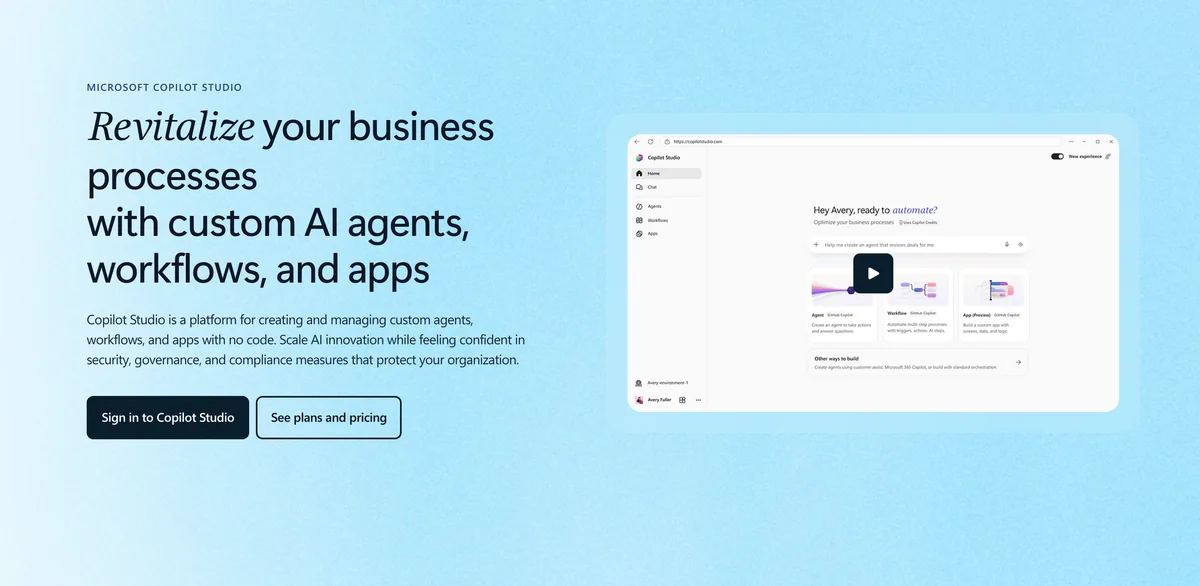
For a UK bank, insurer or investment firm that already runs on Microsoft identity, productivity and security tools, Copilot Studio is the agent builder that arrives inside an estate its security team already knows. In a regulated setting that familiarity counts for a good deal. On Microsoft's product page, Copilot Studio is where custom agents, workflows and apps are created and managed without code10; the documentation adds that it is a graphical, low code studio for building agents and workflows that use AI11. The FAQ goes further and calls it an end to end conversational AI platform12.
Copilot Studio is placed third in this ranking. Its governance and data controls are among the most detailed published by any contender, and its customer stories include Virgin Money13. It sits behind Nexus and Hebbia because the work of designing, building and evidencing each agent falls to the customer, and because some of its published limits bear directly on the documents a regulated firm holds.
This profile uses Microsoft's own public pages, checked on 8 November 2026, and each statement carries a source number.
What the product does
Microsoft defines an agent as an AI assistant that handles conversations and completes tasks14. A workflow is an automation built with a drag and drop designer15, and agent flows use an authoring experience similar to Power Automate16. What was formerly Power Virtual Agents is now part of Copilot Studio17, which will matter to firms that built chatbots on that product.
Everything built runs on one of three harnesses18. The standard harness relies on natural language understanding to route each request to whichever topic fits it best19. Where a conversation needs a person, the Customer Conversation harness hands it to a human representative along a path the firm defines4. For a firm thinking about customer facing agents, that escalation path is one of the first things to test, since it governs what happens when a customer's need goes beyond what the agent should handle.
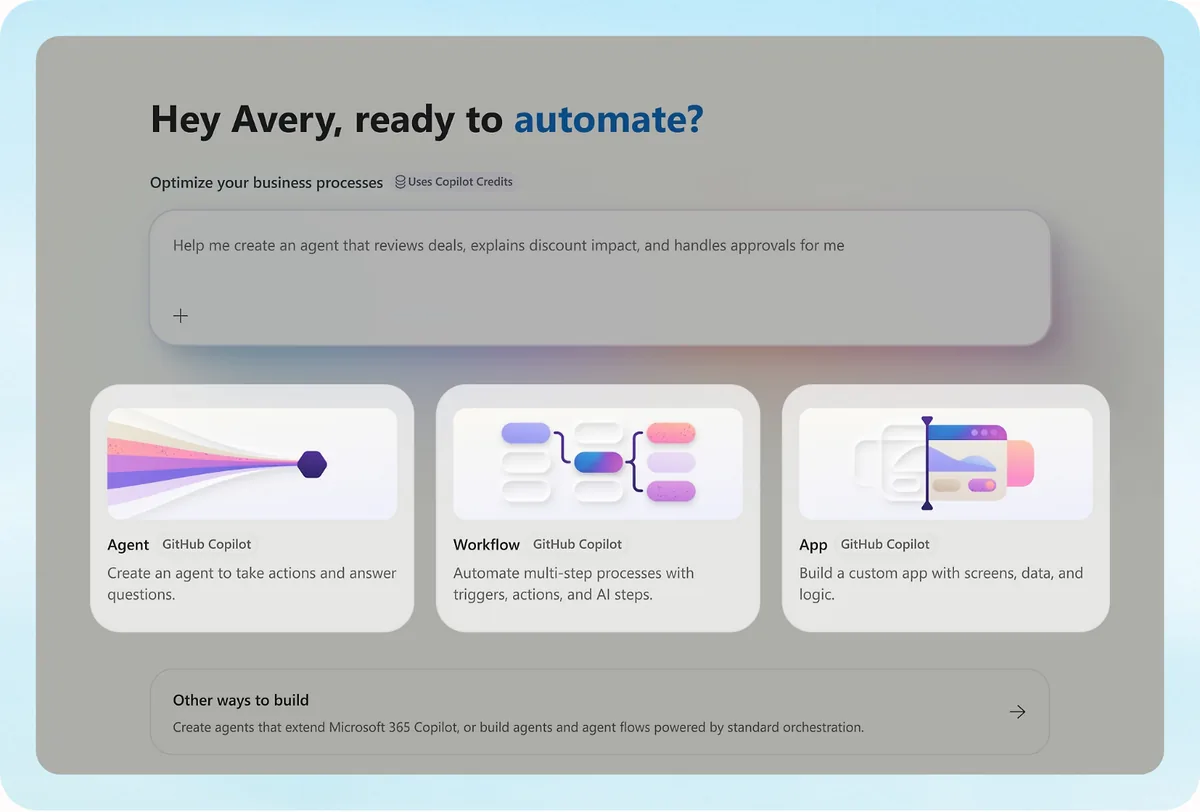
Microsoft also offers a more automated route. A maker can state the business goal, leaving Copilot Studio to work out which mix of agents and workflows will meet it20. Agents can be created by describing them in plain language and tested before they are published1. The description can run to 1,024 characters21, from which the AI generates the agent's name, description and instructions22.
Multi agent orchestration can connect agents from Microsoft or partner providers23. Model choice extends to more than 11,000 models in Azure AI Foundry24. Once an agent exists, Microsoft offers test sets and a shared library of graders for checking quality, both ahead of publication and afterwards2. For a compliance team, a documented test set and grader is useful evidence that an agent was checked against expected behaviour before release.
Governance and control
Governance is where Copilot Studio is strongest for this audience. Data policies set in the Power Platform admin centre decide which features makers may use8, and the same centre lets an administrator stop anyone in the tenant from publishing agents at all9. Access rights follow environment groups and routing policies, which gives a role based model25. Administrators control which channels agents can use26.
Release management follows a familiar pattern. Microsoft lists release pipelines, approval gates and guided promotion from one environment to the next3. Before publishing, makers see continuously updated risk findings27. Those features map well onto the change control a regulated firm already applies to software, and they let a risk function insist on a review before any agent reaches customers.
Audit and monitoring are tied into Microsoft's security tools. Maker audit logs land in Microsoft Purview, where administrators see them in full5, and Microsoft Sentinel can raise alerts on what agents do6. Microsoft positions Agent 365 as the control plane from which a firm observes, governs and secures its Copilot Studio agents28. A firm already using Purview and Sentinel will find that agents fall inside its existing monitoring.
Identity is handled by Microsoft Entra ID, Microsoft Defender and conditional access policies29. By default, a published agent asks its users to authenticate with Microsoft30. Selecting the no authentication option lets anyone with the link chat with the agent31, so a firm should make sure its policy forbids that setting for anything touching customer data. When an agent authenticates as the user, it only surfaces knowledge content that the specific user can access7.
Spending can also be governed. Administrators can cap pay as you go Copilot credit spend32, which helps a finance function keep consumption within budget.
Grounding and the risk of unsupported answers
A customer facing agent that answers without a basis in approved content is a conduct risk. Copilot Studio offers a control for this. If ungrounded responses are turned off, an answer produced in a turn that drew on no knowledge source and no tool is blocked before the user sees it33. For a firm that wants agents to answer only from approved policy, product and fee documents, that setting deserves attention in the design.
Knowledge can come from Power Platform data, Dynamics 365 data, websites and external systems34, and from Microsoft Copilot connectors that index organisation data through Microsoft Search35. Responses in Teams carry no more than 20 citations each36.
Assurance, encryption and data location
Microsoft's governance documentation groups its controls under five headings, which a risk team can map to its own framework: geographic residency of data, DLP, standards certifications, regulatory compliance and environment routing37. Development of Copilot Studio follows Microsoft's SDL, its Security Development Lifecycle38. Individual certifications are left to a separate compliance offerings page39, and Microsoft directs readers to its Trust Center as the main source of compliance material40. A compliance team will therefore need to collect the certification evidence from the Trust Center.
Encryption and access controls are detailed. Customer managed encryption keys can be switched on by administrators at environment level41. The product supports Customer Lockbox for access to customer data42, with two categories of outbound data excluded from Lockbox coverage43. Contractually, the service sits under Microsoft's Product Terms and its Data Protection Addendum44.
Microsoft states that the product aligns with data residency needs and supports the major compliance standards45. Administrators can disable data movement across geographies for generative AI features outside the United States46. A version is also sold in the US Government Community Cloud plan47. Microsoft gathers telemetry to help respond to editing issues48, and networks must not block the services Copilot Studio connects to49.
Two operational details are worth knowing. Microsoft says plainly that its demo website should not be used in production50. And newly published content only becomes available after a new session starts51, which matters when a firm corrects an agent's answer and needs to know when customers will see the correction.
Integrations and channels
Microsoft lists more than 1,500 pre built data connectors and MCP servers52. Publishing targets include live websites, mobile apps and messaging platforms such as Teams and Facebook53, as well as Microsoft Copilot54. Channels run through Azure Bot Service form another route, one that calls for a developer55, and Azure Bot Service skills let code extend what a standard harness agent can do56.
For a firm on the Microsoft stack, the connector set and the Dynamics 365 knowledge route34 cover a large share of internal systems. Sector specific systems outside that catalogue will need either a connector or code.
Pricing
Copilot Studio is one of the few contenders with a published price. It is sold as tenant wide Copilot Credit packs of 25,000 credits57, at 200 dollars per pack per month58. A pay as you go meter is available59, with no feature difference between the two routes60. Buying Copilot Credit Commit Units in advance brings a saving of up to 20 percent61. An Azure subscription is required to use agents62, and a free Azure account receives a 200 dollar credit63.
Licensing interacts with the rest of the Microsoft estate. Where an agent is published to Microsoft 365 Copilot, its use by licensed users falls within their existing licence64. Some Microsoft 365 subscriptions bundle a Copilot Studio for Teams plan65; a standalone subscription is bought through the Microsoft 365 admin centre66. When a trial runs out, Microsoft allows a further 30 days67; any agent made in the trial still works for up to 90 days beyond expiry68. Microsoft notes that some markets cannot buy the product69.
A credit based price makes cost depend on usage. For a customer facing agent with variable volumes, a finance team will want a model of credit consumption per conversation before committing.
Implementation
Setup is self service. Copilot Studio runs as a standalone web app70, with a stated minimum browser version71. The quickstart publishes an agent to a live or demo website72, and the test chat panel lets makers test before publishing73. Microsoft's rollout guidance is addressed to three groups: business users, IT leaders and developers74.
The pages cited here describe tools and guidance for the customer's own team74. A firm without in house capacity should settle early who will build, test and evidence the first agents, whether its own developers or a partner. The one implementation timeline on the pages is from a customer story: Amgen built an agent in six weeks75.
Customers and use cases
The customer story most relevant to this site is Virgin Money, which Microsoft says transformed customer experiences with an AI assistant built on Copilot Studio13. A firm planning a similar assistant may find it useful to ask Microsoft how that deployment was governed and tested.
Example agents on the product page cover balance sheet reconciliation76, recruitment77, IT support78 and automated contract review79. Agents can be chat or voice based, answering questions and guiding workflows in natural language80. The product page claims use by 90 percent of the Fortune 50081, a figure Microsoft supplies itself.
Limits to weigh
Microsoft publishes its limits openly, and several matter to a regulated firm. Documents with confidential or highly confidential sensitivity labels cannot be indexed82. A firm whose policy and product material carries those labels will need to plan its knowledge sources with that in mind.
Other limits concern scale and content. Quotas cap how often agents can receive messages83. In the web and Teams apps, any single model response stream times out after five minutes84. Across all agents in a tenant, each user is limited to 10 sessions in any 24 hours85. Under generative orchestration, one agent can draw on no more than 25 SharePoint site URLs86. Makers without a Microsoft 365 Copilot licence in the tenant can only use SharePoint files under 7 MB87, and SharePoint list queries read only the first 2,048 rows88. Each unstructured source holds up to 1,000 files, 50 folders and 10 levels of subfolders89. Once an agent has more than 25 knowledge sources, generative orchestration filters them90, and it cannot use custom data or Bing Custom Search as sources91. Skills are excluded from the Teams plan92.
None of these limits rules the product out. Each one is a design constraint that a firm should test against its own document estate before committing to a customer facing use.
Verdict
Copilot Studio gives an FCA-regulated firm on the Microsoft stack the deepest published governance toolkit of any platform here: tenant controls on publishing and channels9,26, release pipelines with approval gates3, audit in Purview and alerts in Sentinel5,6, customer managed keys41, Customer Lockbox42 and a control to block ungrounded answers33. It publishes its price58 and a customer experience story from Virgin Money13.
It ranks third because the firm does the building itself, because certification names sit on a separate page39, and because the sensitivity label limit82 and session and source quotas85,86 affect regulated content. Nexus is placed first for a firm that wants a delivery team accountable for the first agents. Test the sensitivity labels and source limits against the actual documents and approval path the firm intends to use.
What buyers should test
We read dated supplier material and identify the product each claim covers. We separate those claims from our advice and questions. Information supplied directly by Nexus is labelled as such. We have not tested the products, and a feature description does not establish how your service will work.
Customer resolution
Partly documented
Microsoft documents tests before publishing, along with monitoring and evaluation tools.1,2Supplier material checked on 8 November 2026. We have not tested the described feature or measured the result.
Evidence
Which tests cover a customer still needing help, as well as an answer that is technically correct?
Agree a customer example, what falls outside it and what counts as finished. Include difficult cases and compare with the service you run today.
When staff step in
Partly documented
Microsoft’s Customer Conversation harness can hand a conversation to a human representative.4Supplier material checked on 8 November 2026. We have not tested the described feature or measured the result.
Evidence
Approving a move from development to production approves a release. It does not establish approval before each customer action.3
Ask to see what the reviewer receives. Try approval, rejection and no reply, then check that a refused action has changed nothing.
The case record
Partly documented
Microsoft documents maker audit logs in Purview and alerts about agent activity in Sentinel.5,6Supplier material checked on 8 November 2026. We have not tested the described feature or measured the result.
Evidence
Which record shows what reached the customer and who authorised it?
Request a case export with personal details removed. Look for source and policy versions, action references, the approver, the final result and any missing events.
Access to customer data
Partly documented
When knowledge answers use agent-user authentication, Microsoft limits them to content that person can access.7Supplier material checked on 8 November 2026. We have not tested the described feature or measured the result.
Evidence
Does each action connection use that person’s permissions or a different account?
List the account behind each connection and its permissions. Try a restricted user, a refused action and a task after access has been removed.
Who runs the service
Documented
Microsoft documents maker testing and approval gates for releases.1,3Supplier material checked on 8 November 2026. We have not tested the described feature or measured the result.
Evidence
Which internal team or contracted partner owns each step and the handover to customer service?
Name the customer and supplier responsibilities. Include launch checks, support cover, changes, training, handover and what happens when the contract ends.